ProteaseTag® Active Neutrophil Elastase Immunoassay
$0.00
The ProteaseTag® Active neutrophil elastase (NE) Immunoassay is a single-use immunoassay based test for the quantitative determination of active human NE in sputum (sol) samples within a basic research or pharmaceutical research setting only. The product is for Research Use Only. It is not for use in diagnostic procedures.
Neutrophil elastase (NE) is a protein biomarker of infection and inflammation is shown to correlate with the severity of several respiratory diseases such as cystic fibrosis, COPD, and bronchiectasis. This establishes NE as a frequently used COPD biomarker and CF biomarker for research. NE has long been used as an endpoint in clinical studies aimed at evaluating the efficacy of new anti-elastase inhibitors (neutrophil elastase inhibitors) or other anti-inflammatory therapies.
Applications
The molecular mechanisms that drive chronic lung disease are heterogenetic. To evolve past a “one drug fits all approach” and towards a more individualized and precise approach, pharmaceutical companies are focusing on drugs that address each etiology within a disease. Hence, endotypes, which are the distinct pathobiological mechanisms driving disease, have come to the forefront in drug design. The endotype approach is also needed for assessing individuals for drug development.
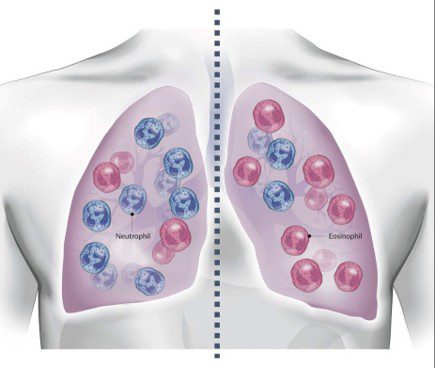
While many cell types can be accounted for in a diseased lung, there is usually one cell type that is the predominant driver of disease. This cell type can vary within a disease and can also change over the course of the disease. This makes endotyping an essential step to identify the distinct inflammatory cell type driving the disease in order to study the disease.
COPD, bronchiectasis, and asthma are most commonly characterized as eosinophilic or neutrophilic endotypes. Neutrophil elastase and proteinase 3 are proteases produced by neutrophils. When released, they facilitate a cycle of tissue damage and inflammation, driving pathology and disease. Measuring the activity levels of neutrophil elastase provides a specific and accurate assessment of neutrophil-driven disease to determine individual endotypes. This makes neutrophil elastase activity measurement an effective tool for drug development studies involving targets that inhibit neutrophil activity.
In addition to endotyping, neutrophil elastase measurement can function as a clinical trial endpoint for general inflammation in lung disease. Inflammation is a hallmark of chronic lung diseases and an important piece to understand when evaluating drug effectiveness. Decreasing lung-specific inflammation is a key strategy for pharmaceutical targets. Currently, the FEV1/FVC ratio is the primary endpoint during pulmonary drug development studies, but does not capture a complete picture of a disease state. Cytokine measurements are frequently recorded, but may not be specific to lung inflammation. Mechanistic markers of inflammation, like neutrophil elastase, can be detected earlier and indicate improvements in outcomes.
ProAxsis offers products that have proven to be valuable in enrolling, stratifying, and studying effectiveness of respiratory drugs in development. The ready-to-use kits offer a sensitive, reliable, and accurate read-out of neutrophil elastase and proteinase 3 activity in sputum sol. From an endotyping perspective, neutrophil elastase and proteinase 3 activity levels are also global mechanistic markers of neutrophil-driven inflammatory states.
Read more about NE as a neutrophil serine proteases (NSP) and biomarker.
Principle of the Assay
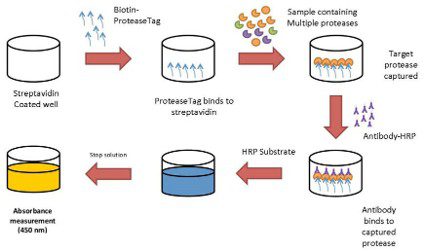
The ProteaseTag® Active NE Immunoassay utilises ProteaseTag® technology to measure and quantify active NE.
During a short incubation, the NE-Tag is coated onto the immunoassay plate before washing to remove excess. Standards and samples are added, and the NE-Tag will interact with the active site of NE during a second incubation. Active NE present in the solutions will irreversibly bind to the NE-Tag while latent and inhibitor bound NE will be removed by washing. A horseradish peroxidase (HRP) conjugated anti-NE antibody is added to each test well and incubated. This detection antibody attaches to bound NE with unbound antibody subsequently removed by washing. A colour forming substrate containing tetramethylbenzidine (TMB) is added to each test well and reacts with HRP to generate a blue coloured product. This enzymatic reaction is subsequently stopped by the addition of acidic stop solution to each test well (a yellow solution is formed). The colour intensity (absorbance) is read at 450 nm using a plate reader.
Main Box Components (stored at 2-8°C)
| Main Kit Components | |
| Immunoassay Plate | 96 well streptavidin-coated microtitre plate (pre-blocked) |
| NE Wash Buffer Concentrate | 24 ml of a 25-fold concentration of buffered surfactant with preservatives |
| NE Reagent Diluent | 4 x 12 ml of buffered surfactant with preservatives (ready to use) |
| TMB Substrate | 10 ml of tetramethylbenzidine (ready to use) |
| Stop Solution | 5 ml of 2 N sulphuric acid (ready to use) |
| Plate Sealers | 4 adhesive strips |
Freezer Box Components (stored at -20°C)
| Freezer Box Components | |
| NE-Tag | 1 vial containing 2.4 µl (concentration 10 mM) of capture probe in N,N-dimethylformamide (DMF) |
| Human Neutrophil Elastase Standard | 1 vial containing 2.5 µl of native NE (concentration 100 µg/ml) in an acidic buffer |
| NE Conjugate | 1 vial containing 20 µl of anti-human neutrophil elastase antibody conjugated to horse radish peroxidase (HRP) in a stability solution |
| Format | 96 well |
| Species | Human |
| Sample | Sputum sol |
| Range | 7.81 – 250 ng/mL |
| LOD | 4.97 ng/m |
| Specificity | Only detects active NE |
| Run Time | 130 mins |
| Use | Single use only |
Active Neutrophil Elastase and Active Proteinase 3 are serine proteases and are currently being used as endpoint measurements in researching efficacy of new inhibitors to these proteases or other anti-inflammatory therapies. With infection or inflammation in respiratory diseases, the concentration of active proteases overwhelms the number of inhibitors, which causes excessive proteolytic tissue degradation, damaging the airway walls and contributing to a destructive inflammatory pathway.
Why choose ProAxsis Respiratory Products?
ProteaseTag® Technology targets only the active form of the protease, thus providing a stronger correlation with pathogenic activity than assays that measure total protease levels (composites of the latent, active and inhibitor-enzyme complexes). Measuring these active proteases in sputum sol shows localized inflammatory activity and response within the respiratory tract.