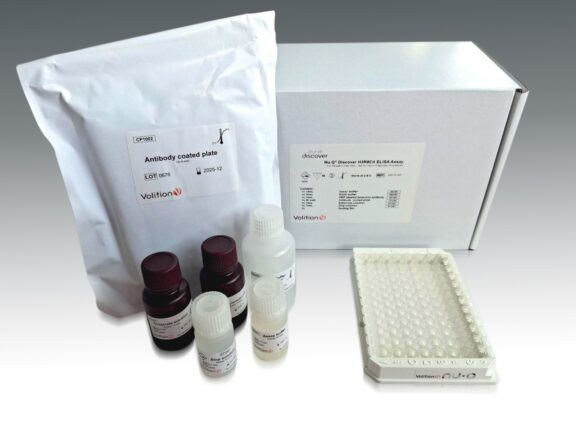
Nu.Q® Discover H3R8Cit ELISA Assay (Prototype Product)
$0.00
The Volition Nu.Q® Discover H3R8Cit ELISA Assay (Prototype Product) kit is a standard sandwich format ELISA. Strips of microwells in a plate are coated with a monoclonal anti-H3R8Cit antibody. The kit includes a set of standards and controls and yields a standardized output of H3R8 Citrulline measured in ng/mL, which may be used as a specific surrogate measure of NETs or NETosis.
Histone H3 is citrullinated post-translationally by peptidylarginine deiminase 4 (PAD4) at residues R2, R8, and R17 during the processes of epigenetic chromatin remodeling and neutrophil extracellular trap (NET) formation. The capture monoclonal antibody used in this assay is H3R8, which is specific to R8.
Background:
Nucleosomes are repeating subunits of DNA and histone proteins that constitute human chromatin. During cellular damage, such as apoptosis or necrosis, chromatin is fragmented into oligo- or mono- nucleosomes which can be released into the blood stream.
A specific cell death process involved with immune function and that results in the release of nucleosomes into biological fluids is known as NETosis. In this process, neutrophils produce neutrophil extracellular traps (NETs), which are long web-like strands of chromatin structures containing nucleosomes and antimicrobial proteins. NETs function to trap pathogens (viral, bacterial, cancer, etc.) and are thought to be protective when properly controlled but harmful if not. Systemically elevated levels of NETs are associated with immune-mediated states.
Given their presence in disease states, measuring NETs and the process of NETosis in a research setting is important. Currently, there are several common methodologies that can directly measure NETs, including NET microscopy and NET flow cytometry. Both methods require NET formation to be captured in process and require laborious sample handling. NETosis ELISA methodologies measure NET components and include dsDNA, histones, nucleosomes, citrullinated histone, granular proteins in complex with DNA, and granular proteins alone. These can be measured via a variety of NETosis ELISA kits (MPO ELISA, MPO+DNA Complex ELISA, total nucleosome ELISA). Some of these NETosis ELISA kits are available commercially, but most are in-house developed assays, which leaves them especially prone to inter-laboratory variability.
The Nu.Q® Discover H3R8Cit ELISA Assay (Prototype Product) kit is a standardized, complete kit that can be used for a wide range of research applications relevant to the study of nucleosomes and (NETs) such as:
- Oncology
- Coagulation
- Sepsis
- Auto-immune Diseases
- Neurodegenerative Diseases
- Inflammation
- NETopathies (neutrophil extracellular trap associated diseases)
- COVID-19
| Standard/Calibrators | 6 vials, 250µL each |
| Kit Controls 1&2 | 2 levels, 250µL |
| Conjugate Anti-nucleosome antibody conjugated with horseradish peroxidase (HRP) | 1 vial, 13 mL |
| Coated microplate with monoclonal Anti-H3R8 Citrulline antibody adsorbed on walls | 12 test strips with 8 wells each |
| Assay buffer | 1 vial 13mL |
| TMB Substrate | 1 vial, 13 mL |
| Stop Solution, Chlorhydric acid 1M (avoid any skin contact) | 1 vial, 13 mL |
| 10X Conc. Wash Solution, Phosphate buffer 40mM, proclin 0.0075%, Tween 20 0.5% | 1 vial, 30 mL |
| Plate foil | 3X |
Standard and kit controls must be stored separately from the rest of the kit at -80°C. Store the other components of the kit at 2-8°C
Under these storage conditions, the unopened reagents contained in the Nu.Q® Discover H3R8Cit ELISA Assay (Prototype Product) may be used until the expiry date printed on their labels. Do not use reagents beyond their expiration date.
Materials required but not provided:
- Purified water
- Adjustable or preset single-channel pipettes able to dispense 20µL
- Multi-channel pipettes able to dispense 50µL to 200µL
- Disposable pipette tips
- Disposable reagent reservoirs
- Vortex mixer
- Volumetric cylinders
- Container for biohazardous waste
- Microplate incubator with orbital shaking facility (shaker at 700 rpm)
- Microplate reader equipped with 450 nm filter and able to read optical density between 0 and 4.0
- Absorbent paper
- Light-tight plate cover
The determination of H3R8cit nucleosome concentration should be performed on K2EDTA plasma samples that have been thawed after frozen storage (-80°C).
Each 96 well plate has the capacity to analyze up to 40 samples.
Important Note: This is a prototype product under development by Volition and has not been produced within any quality management system. This product is not intended for clinical diagnosis, patient management, or any investigation that is not exempt from 21 CFR part 812.