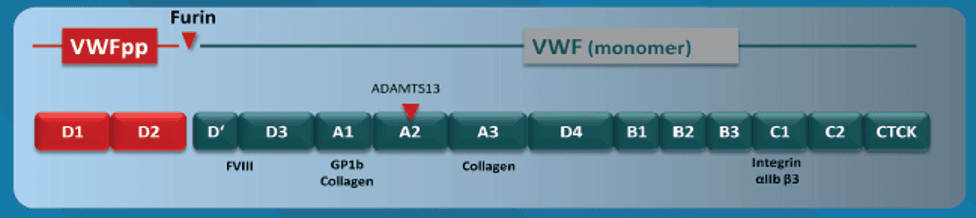
von Willebrand Factor (vWF) is a large, multimeric protein secreted from endothelial cells and present in both plasma and platelets. At sites of vascular injury, it plays an essential role in primary hemostasis by promoting platelet adhesion and aggregation. In secondary hemostasis, it acts as a carrier protein for Factor VIII in plasma. Before it can perform these functions, it has to be properly assembled, processed, and stored. That is where von Willebrand Factor Propeptide (vWF:pp) comes in.
vWF is synthesized as a precursor protein. After several posttranslational modifications and cleavage of the signal peptide in the trans-Golgi-system, the protease furin cleaves the propeptide of VWF (VWF:pp). vWF:pp remains associated to VWF in Weibel Palade bodies in endothelial cells or in α-granules of megakaryocytes, resulting in one molecule vWF antigen (vWF:Ag) and one molecule vWFpp (vWF:pp). Stimulation of these cells releases the complex into plasma, and secretion of vWF:pp is also equimolar to vWF:Ag as one non-covalent complex.
But, once in the plasma, vWF:Ag and vWF:pp dissociate and circulate independently. The normal range for the concentration of vWF:pp in plasma is reported to be ~1μg/ml verses the normal range for the concentration of vWF:Ag, ~10 µg/ml. This discrepancy is due to difference in metabolism and clearance of each, which results in a much shorter plasma half-life for vWF:pp than for vWF antigen (2 hours vs 12 hours, respectively).
Deficiencies in either the amount or function of vWF can lead to bleeding diathesis. Functional defects are attributed to increased or decreased platelet binding, decreased Factor VIII binding, decreased collagen binding, decreased self-aggregation (i.e. formation of multimers) and decreased GP1b binding. Insufficiencies in levels of vWF in the plasma are attributed either to decreased production of pro-vWF or faster rates of degradation of vWF in the plasma. Understanding the mechanism of vWF deficiency is important because effective intervention varies depending on the source of the vWF defect.
Assessment of von Willebrand Factor propetide (vWF:pp) levels in plasma is one such way to elucidate the source of vWF deficiency in research studies.
Determination of vWF:pp levels can yield additional information in von Willebrand Disease (VWD) research. Quantitation can help to pinpoint the source of vWF defects and provide clues to more effective mechanisms of rectifying the vWF deficiency. If the levels of vWF:pp detected in plasma are higher than the levels of vWF:Ag, it can be deduced that the source of the vWF defect may be in degradation rate verses pro-vWF production. On the flip side, if the amount of vWF:pp detected is similar or less than that of vWF:Ag, the defect may be in pro-vWF production verses vWF degradation.
The VWF:pp / VWF:Ag ratio can be used to study the differentiation of VWD types. VWF:pp could be measured to study acquired VWD in research fields like ECMO (extracorporeal membrane oxygenation) test plasma, cardiac disorders (e.g. aortic stenosis, congenital cardiac defects, mitral valve prolapse), in hematoproliferative diseases, monoclonal gammopathy, myeloma, other lymphoproliferative disorders, immunologic diseases, (e.g. SLE); thyroid disorders, diabetes, nephropathies, DIC, sepsis and other diseases.