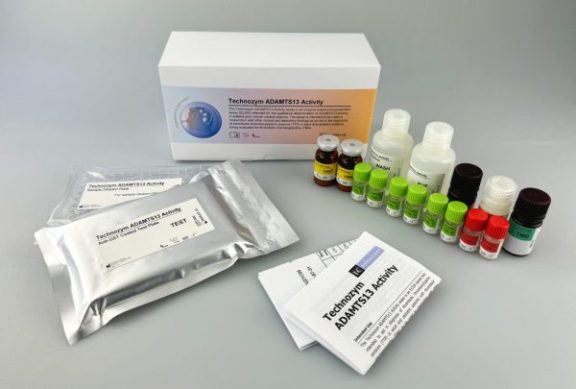
Technozym® ADAMTS-13 Activity (IVD)
$0.00
The Technozym ADAMTS13 Activity assay is an enzyme-linked immunosorbent assay (ELISA) intended for the determination of ADAMTS13 activity in platelet poor human citrated plasma. The assay is intended to be used in conjunction with other clinical and laboratory findings as an aid in the qualitative diagnosis of thrombotic thrombocytopenic purpura (TTP) in adult and pediatric patients being evaluated for thrombotic microangiopathy (TMA).
Advantages:
- Easy ELISA kit that, when bringing testing in-house, can lead to significant cost savings for healthcare systems
- Adaptable to different 96-well microplate readers with the requirement only being to have capacity to read at a wavelength of 450 nm
- Turn-around-Time within 4 hours
- Calibrators and controls included within each kit
Reagents, Composition, Storage and Stability:
| ELISA test strips | 12 with 8 wells each, coated with a monoclonal anti GST- Antibody. The drying agent is supplied in an aluminum bag. Stability after opening at 2-8°C with adhesive film in aluminum bag with drying reagent: 6 weeks. |
| GST-vWF73 Substrate | 2 vials; lyophilized; 6 mL. After reconstitution, stability at ≤ -20°C: 6 weeks. |
| Calibrators | (standards) numbered from 1 to 6; lyophilized; 1 vial each; 0.5mL. After reconstitution, stability at ≤ -20 °C: 6 weeks. |
| High and Low control plasma | 1 vial each, lyophilized; 0.5 mL. After reconstitution, stability at ≤ -20°C: 6 weeks. Concentrations are lot-specific; consult the label on the vial. |
| Reaction buffer | 1 vial; 30 mL; ready to use. After reconstitution, stability at 2-8 °C: 6 weeks. |
| Conjugate | HRP conjugated monoclonal antibody specific to the cleavage site: 1 vial; 12mL; ready to use. After opening, stability at 2-8 °C: 6 weeks. |
| Color reagent TMB | (Tetramethylbenzidine); 1 vial; 12mL; ready to use. After opening, stability at 2-8 °C: 6 weeks. |
| Wash Buffer concentrate | 10-fold concentrated, 1 vial; 53 mL. Stability of wash buffer concentrate after opening at 2-8 °C: 6 weeks; After 1+9 dilution of concentrate, stability at 2-8 °C: 6 weeks. |
| Stop solution | Sulfuric acid 2.5%, 1 vial, 12 mL; ready to use. After opening, stability at 2-8 °C: 6 weeks. |
| Sample dilution Microplate | 1 plate, uncoated (ONLY for sample dilution!). |
The expiry date printed on the labels applies to storage of the unopened vial at 2-8 °C.
Background
ADAMTS13 (a disintegrin-like and metalloproteinase with thrombospondin type 1 motif 13) is an enzyme (vWF-cleaving protease or vWF-CP) that specifically cleaves von Willebrand Factor (vWF) multimers. It is important for preventing the accumulation of ultra-large vWF multimers, the persistence of which can lead to mircothrombi in the vasculature.
First-generation assay methods used to measure ADAMTS13 activity involved use of either plasma-derived or full-length recombinant multimeric vWF substrate. These assays were time consuming (from 2 to 4 days) and difficult to reproduce between testing centers. The development of vWF peptide substrates circumvented many of these issues, leading to a turn-around time of only 2 to 4 hours. ADAMTS13 substrates (i.e., FRET substrates) were eventually developed into commercial kits.
While using a peptide substate, most commonly, vWF73, led to advances in assay technology and standardization, key differences in the specific technology used in each kit led to limitations of various assays and discrepant results depending on kit manufacturer. Some limitations occur in any method for measuring ADAMTS13 activity but minimizing interferences and ensuring accurate measurement at very low ADAMTS13 activity levels are critical features for this biomarker.
One popular assay method, fluorescent resonance energy transfer (FRET), was found to have limitations resulting from interferences of plasma proteins like hemoglobin and bilirubin. Bilirubin absorbs light at the same wavelengths as the chromophores in FRETS-vWF73; hemoglobin absorbs at a close wavelength of 550 nm and also directly inhibits ADAMTS13, regardless of the assay method. It’s possible to lessen these issues by dilution, but this can result in limiting assay sensitivity, which is crucial for measuring ADAMTS13 activity. Liquid-phase FRET assays were developed but these were found to be subject to discrepancies due to of cleavage of the ADAMTS13 substrate by other proteases, such as elastase.
Understanding that the ADAMTS13 activity level in a plasma sample can vary depending on disease condition, which can subsequently result in abnormal levels of other plasma proteases and proteins, it became important to develop an assay that would minimize protease interference. It was found that this could be accomplished if, during the assay, the ADAMTS13 protein is first captured on a plate followed by washing prior to adding the FRET substrate. Thus, ELISA plate-based methods were found to reduce or even eliminate these chemical interferences.
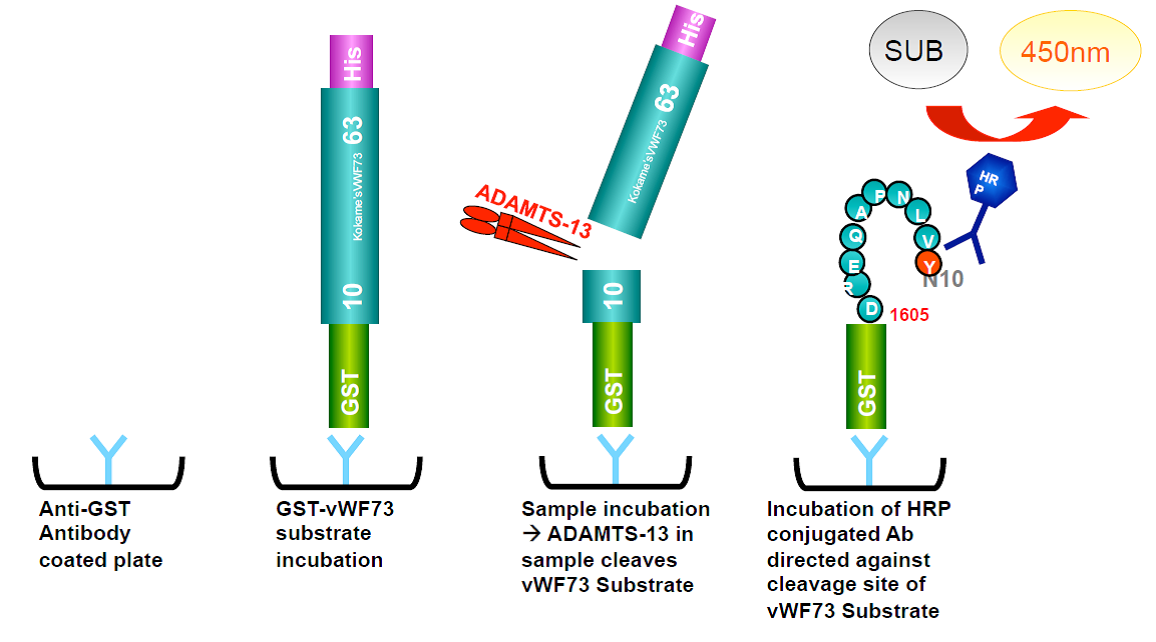
An additional advancement in assay methodology came about which made use of standard chromogenic ELISA (HRP/TMB) reagents thus avoiding the need for a fluorescent reader. In this approach, a peptide vWF substrate is still used but in a modified-ELISA approach that first captures the substrate onto the plate. Then, with addition of ADAMTS13 from the sample, it cleaves the peptide to expose a neo-epitope. This new epitope is recognized by a specific antibody allowing ADAMTS13 activity to be determined by ELISA. A high sample dilution (1:31) avoids bilirubin and hemoglobin interference. In addition, protease interference is minimized when using a capture antibody very specific to the ADAMTS13 cleavage site (Tyr1605-Met1606).